
Puente, on Urda: the control centre had 17 minutes and Iryo warned five minutes before the collision that it was still stopped
Topics Adif
The Minister of Transport gives the full sequence for the first time: the AVE departed with a normal running order and a green light. He defends the LZB, puts its falls this year at 170, announces that he will review the protocols and rules out resigning.
Redacción ·
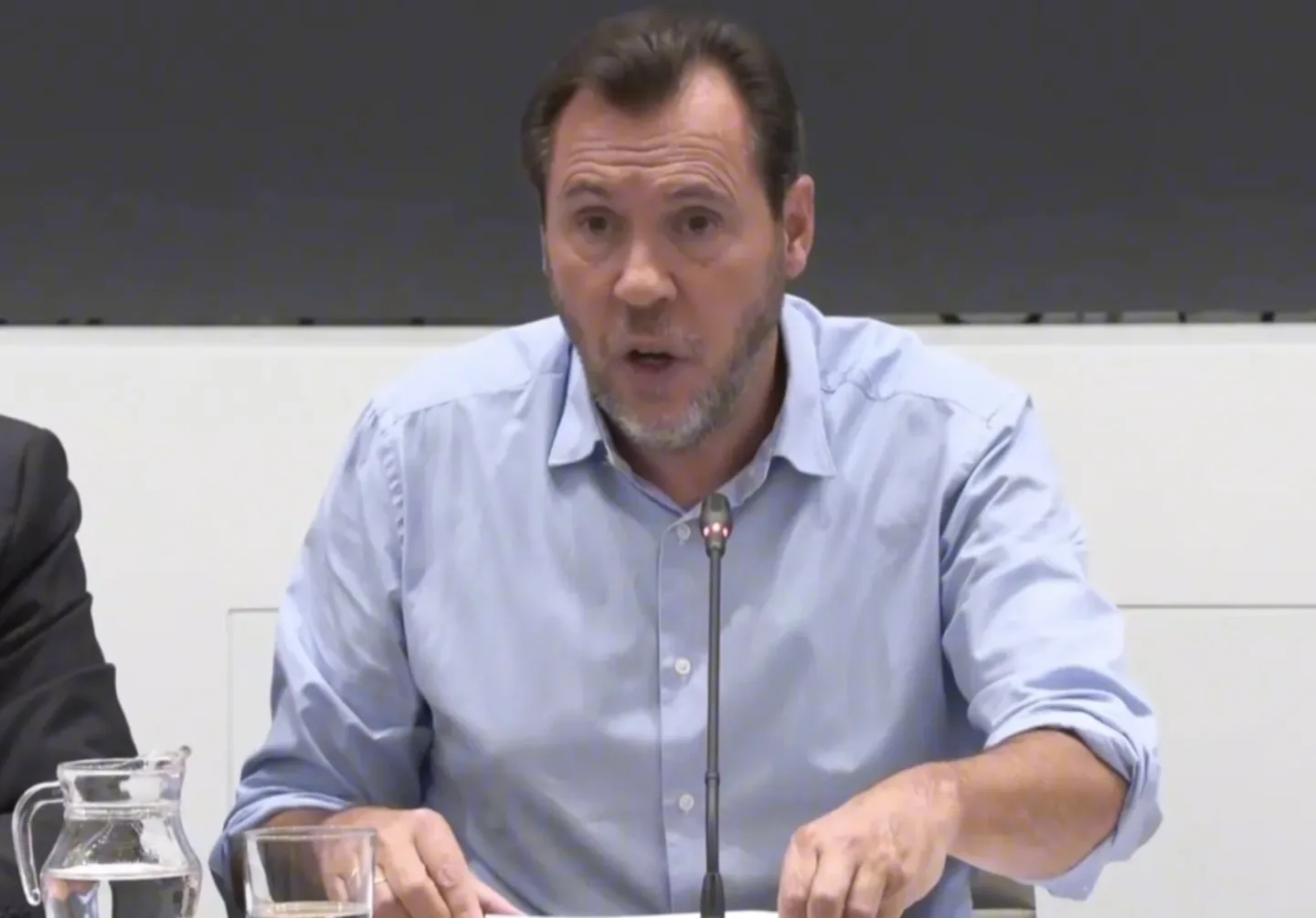
The Minister of Transport, Óscar Puente, explained this Friday, October 30, at a press conference at the Ministry, lasting almost two hours, the sequence of the Urda (Toledo) crash "based strictly on the records consulted, both visual and auditory." At 8:48 the driver of the Iryo train notified the Adif control center at Atocha that she could not resume movement. "The center received the message, but took no action," he said. Meanwhile, the AVE had already set off: it traveled about 25 kilometers, exceeded 160 km/h and collided with the Iryo at around 8:53. From the time the AVE was authorized to resume movement until the impact, "approximately 17 minutes" passed. "Why, if action could be taken and there was time, is nothing done? I have no idea at all," he said.
Two trains in the same block
When the LZB, the system that controls braking in high-speed rail, failed, the backup system, the ASFA, came into operation, with much longer track sections (blocks). The two trains ended up within the same block: the Iryo, at the entry signal to Urda, and the AVE, shortly after the entry to the section. According to Puente, the rules for the control center in that situation are "elementary and basic": the train behind does not move until the one ahead has set off and left the block, and then it advances "on sight," at a maximum of 40 km/h, to the next signal.
That day, he said, the AVE was given the order to resume movement "normally" and, a few minutes later, the signal ahead of the Iryo turned green so that it could leave. Since the Iryo could not set off, the signal remained green and the AVE received no warning when it reached the end of the section. At the control center, he said, the screens showed where each train was, and on them "you dramatically see how one train gets closer and the other remains stopped." The protocol for this situation "is set out in regulations and in an Adif instruction, and it is not the decision that was taken" by the operator. The operator has been removed from service, and his situation now depends on the judge. He had two years of experience in control centers and had been in that sector since February. There were 16 controllers in the room, and as soon as the situation deteriorated an assistant was assigned to him.
Puente insisted that he has never spoken of "human error": "I have limited myself to communicating objective, confirmed, verified and verifiable facts." He recalled that the causes will have to be clarified by "the investigation and the Justice system." "I am not a judge." On why the Iryo could not set off, he said he does not know. The driver says in a conversation that she could not re-arm the LZB, but that "must be the subject of the investigation." "It was stopped. Period."
The LZB and the ERTMS
According to the minister, it is not yet known what caused the communication failure between the computers at the Urda center, which appears to be a synchronization problem. Hitachi Rail has to analyze the records when the judge allows it. The LZB has failed 170 times in 2026 across the entire network, a figure "within European normality." 75% of those failures are due to causes unrelated to the system, such as cable theft, vandalism or works. On the affected line there have been 13 this year, and the previous one was on October 14. He denied that there were works or tests in the area that influenced the accident.
He argued that the LZB is "as solid and as reliable" as the ERTMS, the European system that will replace it. It is used, for example, by 80% of German high-speed rail. The change is being made because of the European obligation to unify systems. On the Madrid-Sevilla line the ERTMS has already been installed since June, but it still needs testing and permission from the State Railway Safety Agency. It will be operational "predictably at the beginning of 2027," about twelve months behind schedule (April 2026).
What will change
"It is clear that a country like ours cannot have two railway tragedies like the ones we have suffered," Puente said. The Government is preparing "a battery of immediate measures" to provide more technical support to those who make decisions in control centers, review protocols and training, and restore confidence in a system that, he admitted, "today clearly does not have it." He does not rule out a full audit, and some decisions could be taken now, on a precautionary basis. The habit of carrying out works without cutting the lines will also be reconsidered, starting with the renewal of the Madrid-Barcelona line.
No resignation
On his resignation, he said he shares with Pedro Sánchez that it is "unacceptable" to have two accidents like this, but that he will not leave because the opposition asks for it. He recalled that the PSOE did not ask for Ana Pastor's resignation after the Angrois accident, in 2013. He said he still believes that the train is safe: "If I believed it was not safe, I would not travel by train or let my family do so." Regarding Fátima Báñez, he expressed his "absolute devastation." "I did not know her, but she certainly inspires affection and sympathy in me, and I deeply regret it," he said.
Puente will appear on Tuesday, November 3, before the Permanent Deputation of Congress. The entire press conference can be seen in the elDiario.es recording. Everything known about the accident, in the AndalucíaYa special.
Breaking news from News, on your phone
An alert only when something can't wait. Free, no account needed.
On iPhone, alerts only arrive if you first add YaSevilla to your Home Screen. How to do it, step by step
This browser can't receive alerts. Try another one, such as Chrome or Safari.
You've blocked alerts from YaSevilla in this browser. You can turn them back on in its settings. How to do it, step by step
Only what can't wait. Change or remove it in my alerts
Shall we let you know what matters?
Phone alerts
On iPhone, alerts only arrive if you first add YaSevilla to your Home Screen. How to do it, step by step
This browser can't receive alerts. Try another one, such as Chrome or Safari.
You've blocked alerts from YaSevilla in this browser. You can turn them back on in its settings. How to do it, step by step